Cabbages and Kings

A diary by the authors of the Louis Kincaid series

My Photo
Name: PJ Parrish
Location: United States

I am writer. It is the only thing I do reasonably well. I wanted to be a Rockette but my legs are too short and I can't do the splits.

Sunday, May 11, 2008

Day 3: What's that smell?


Okay, here we are, Day 3 of the New Book Diary, and I am still struggling with my opening paragraph. What do you think of this one?

The deep waters, black as ink, began to swell and recede into an uncertain distance. A gray ominous mist obscured the horizon. The ocean expanse seemed to darken in disapproval. Crashing tides sounded groans of agonized discontent. The ocean pulsed with a frightening, vital force. Although hard to imagine, life existed beneath. It's infinite underbelly was teeming with life, a monstrous collection of finned, tentacled, toxic, and slimy parts. Below its surface lay the wreckage of countless souls. But we had dared to journey across it. Some had even been brave enough to explore its sable velveteen depths, and have yet to come up for precious air...."


Yeah, that's what I thought. Whee, doggies! What's that smell?

But I didn't write it, thank god. It is the opening of a project created by Penguin and wiki called "A Million Penquins." Maybe you heard about it when it was announced a couple months back. The idea was to write a novel with a million collaborators.

And Kelly and I thought we had it tough with just two.

This is what the Penguin folks said on their website: "We've created a space where anyone can contribute to the writing of a novel and anyone can edit anyone else's writing....we want to see whether a community can really get together, put creative differences aside (or sort them out through discussion) and produce a novel."


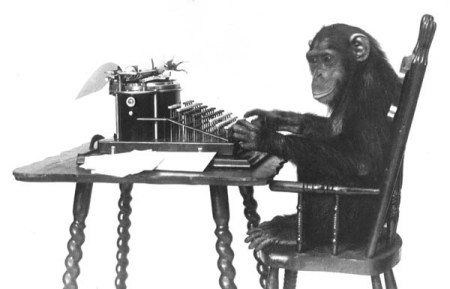
Turns out there were only 1,500 contributors. But that was 1,499 too many from the looks of things. But I guess this at least proves that the Infinite Monkey Theorum just might be true after all.

If you want to read the whole Penguin novel, here's the link. As for me, I think I better get back to work. I hear the footsteps of a million monkeys on my ass...

Tuesday, May 06, 2008

Day 2: Hook, lines and stinkers

The opening line of a book is the single hardest line you write.

Many writers would disagree with that. But for my money, they are: A. those lucky devils for whom all things come easy; B. those diligent do-bees who can scribble down anything just to get started and then go back and rewrite or C. those types who aren't really very good at what they do or maybe are just phoning it in.

I know, that sounds a little harsh. But I truly believe this. I have great respect and envy for writers who create great openings and little regard for those who never even try. And can't you tell the difference?

I am not talking about "hooks." I'm talking about those rare and glorious opening moments in great stories that are telling us, "OOheee, something special is about to happen here!" Hooks? That's easy. I am firmly of the mind that anyone can write a decent hook. You've seen them, those clever one-liners tossed out by wise-ass PIs, those archly ironic first-person soliloquies, those purple-prose weather reports that substitute for mood.

We crime writers talk alot about great hooks -- getting the reader engaged in the first couple pages. We worry about whether we should throw out a corpse in the first chapter, whether one-liners are best, if readers attention spans are too short for a slow burn beginning. This is especially true if you are writing what we categorize as "thrillers."

But I'm tired of hooks. I'm thinking that the importance of a great opening goes beyond its ability to keep the reader just turning the pages. A great opening is a book's soul in miniature. Within those first few paragraphs -- sometimes buried, sometimes artfully disguised, sometimes signposted -- are all the seeds of theme, style and most powerfully, the very voice of the writer herself.

It's like you whispering in the reader's ear as he cracks the spine and turns to that pristine Page 1: "This is the world I am taking you into. This is what I want to tell you. You won't understand it all until you are done but this is a hint, a flavor, of what I have in store for you."

Which is why, today on Day 2, I am still staring at the blank page. Nothing has come to me yet and I know that I can't move forward until I find just the right key to unlock what is to come. I sit here, staring at my blank Wordperfect page, thinking that if I can only make good on my beginning's promise, everything else will follow. Because that is what a great opening is to me: a promise to my reader that what I am about to give them is worth their time, is something they haven't seen before, something that is...uniquely me.

Oh hell, I'll let Joan Didion explain it. I have a feeling she's given this a lot more thought than I have:

Q: You have said that once you have your first sentence you’ve got your piece. That’s what Hemingway said. All he needed was his first sentence and he had his short story.

Didion: What’s so hard about that first sentence is that you’re stuck with it. Everything else is going to flow out of that sentence. And by the time you’ve laid down the first two sentences, your options are all gone.

Q: The first is the gesture, the second is the commitment.

Didion: Yes, and the last sentence in a piece is another adventure. It should open the piece up. It should make you go back and start reading from page one. That’s how it should be, but it doesn’t always work. I think of writing anything at all as a kind of high-wire act. The minute you start putting words on paper you’re eliminating possibilities
.

Didion gave this interview around the time she published her great memoir after her husband's death "The Year of Magical Thinking," the first line of which is: "Life changes fast."

Maybe I am more hung up than usual on openings because I have read some really good books lately.

I was born twice: first, as a baby girl, on a remarkably smogless Detroit day in January of 1960; and then again, as a teenage boy, in an emergency room near Petoskey, Michigan, in August of 1974.

Wonderful opening, that one, from Jeffrey Eugenides's "Middlesex." Because there in that one deceivingly simple declarative sentence lies the all tenderness, irony and roiling epic scope of his story.

And then there was this one:

The village of Holcomb stands on the high wheat plains of western Kansas, a lonesome area that other Kansans call "out there."

That one is from Truman Capote's "In Cold Blood." This is the first line of a long paragraph of description that opens the book, yet look at what it accomplishes -- sets us down immediately in his setting, conveys the book's bleak mood and hints with those two words "out there" that he is taking us to an alien place where nothing makes sense (the criminal mind).

And here is the one I just started last night. I think you will recognize it:

Lolita, light of my life, fire of my loins. My sin, my soul. Lo-lee-ta: the tip of the tongue taking a trip of three steps down the palate to tap, at three, on the teeth. Lo. Lee. Ta..

I don't know whether to laugh or cry (out of envy) when I read that one.

What is so terrifying about openings, I suppose, is that you only have so much space to work with: the first line, the first paragraph, that's it. Because once you've moved deeper into that first chapter, that golden moment of anticipation is gone and then you the writer are busily engaging all the gears to move the reader onward. The opening is the moment before the kiss; the rest is relationship. And you only have precious seconds to make a good impression.

I read a lot of crime novels. I do this to keep up with what's going on in our business but I also do it out of pleasure. But it seems to me that lately I am reading too many genre books that just aren't trying hard enough, and you really can see it in the openings. Maybe this has something to do with the pressure to put out a book a year. Maybe I am reading the wrong people. But I do find myself wishing for less "hook" and more artfulness.

But that said, I pulled a couple books from my crime shelf and found some "oldies" that I liked.

We were about to give up and call it a night when somebody dropped a girl off the bridge. -- John D. MacDonald, "Darker Than Amber"

They threw me off the hay truck about noon. -- James M. McCain, "The Postman Always Rings Twice"

The girl was saying goodbye to her life. And it was no easy farewell. -- Val McDermid, "A Place of Execution."

Not bad for one-liners. Then there are the more measured openings:

Death is my beat. I make my living from it. I forge my professional reputation on it. I treat it with the passion and precision of an undertaker - somber and sympathetic about it when I'm with the bereaved, a skilled craftsman with it when I'm alone. I've always thought the secret of dealing with death was to keep it at arm's length. That's the rule. Don't let it breathe in your face.
But my rule didn't protect me
.

That's one of my favorites from Mike Connelly. It's from "The Poet" and it works because it succinctly captures his protagonist's voice and the theme of the story.
There is a bullet in my chest, less an a centimeter from my heart. I don't think about it much anymore. It's just a part of me now. But every once in a while, one a certain kind of night, I remember that bullet. I can feel the weight of it inside me. I can feel its metallic hardness. And even though that bullet has been warming inside my body for fourteen years, on a night like this when it is dark enough and the wind is blowing, that bullet feels as cold as the night.

Lovely writing from Steve Hamilton and see how the bullet, the setting and the key point of Alex McKnight's backstory coalese around theme?

These are some of the few who know the difference between a hook and an opening. These are the writers among us. These are the folks who understand that sometimes you have to write the opening last, like Picasso signing his painting. Because the great opening is the writer's true signature.


Thursday, April 17, 2008

Diary Day 1: On with the show!


Overture, curtains, lights,
This is it, the night of nights!
No more rehearsing
and nursing a part
We know every part by heart
Overture, curtains, lights
This is it, you'll hit the heights
And oh what heights we'll hit
On with the show this is it!


Well, the curtain is about to go up on Book No. 10. And though that makes me a veteran on this crime writing stage, I still have first night jitters.

Writing that first paragraph never gets easier, folks. You'd think it would be rote by now. But starting a new book, confronting that awful field of white on the NEW Wordperfect document -- it is painful for me. Not just psychicly painful. Physically painful. Like stomach-knotting, heart-palpatating painful. (I've been telling myself it's just the diverticulosis but it's not). I have been putting this off for weeks now, procrastinating with every conceivable excuse. First there was SleuthFest. Then there was a friend's visit. Then I had to prepare for the Edgar symposium. And there was that critique I had been putting off. And all that laundry to be folded...

Of course, the longer you wait, the worse it gets. Because writing is exactly like exercising. If you stop doing it, your energy flags, your muscles atrophy, your mind grows cobwebs. You get fat and lazy. Then get you depressed because you've gotten fat and lazy.

Why is this so difficult? It's a confidence thing. Every time Kelly and I start a new book, I am scared shitless that this is the one that will reek. I'm terrified that we have run out of gas; that our ambivilence is showing and we will become one of those pathetic writers who phone it in. I'm worried that we don't have the energy to do it again. I'm thinking that this is the plot that is pallid, that this story is shapeless. I am certain that this is when it will all fall apart and everyone will see me for the fraud I am.

But...

Then I remind myself that once things get going -- oh, around chapter 20 or so -- it will come together. It will become fun again. I remind myself that I have been here before and come out the other end okay. I remind myself that every book feels like you are pushing a mamoth boulder up a hill until that beautiful moment when you crest and then you race downhill in an exhilarating rush. I remind myself that I am so damn lucky to have a contract in these tough times, to have the support of a fine editor and publisher, to get paid to think stuff up, to have readers who buy our books and write us emails of thanks. I remind myself about all of this and try to stop whining and do my job.

The good thing is, there is redemption even for scofflaws. There is always another day, a new chance. Another Monday....

Today is Monday. Today, I typed out CHAPTER ONE. (hey, it's a start, man!) But then I made a short detour here. Because I am going to try something new with this book. I am going to begin each day's writing with a short diary entry here about my progress. Yes, yes....I KNOW that is procrastination of sorts. Blogging, as we all know, is a huge time suck. As one of my favorite editor types Neil Nyren put it recently over at Murderati: "Blogs – I probably shouldn’t be saying this -- but sometimes I wonder if all the time and energy spent on writing a blog might not be better spent on…well, you know what I’m going to say."

But for me, in the past, this blog has also been like a quick set of jumping jacks. See, I figure just the fact that I have to come here and move my fingers over the keyboard might get my lard ass in gear again for the heavy lifting of fiction.

So, this is my first entry in a diary that will chronicle my trip on this curious winding road called writing. Destination: Untitled Book No. 10. Length of journey: as long as it takes. ETA: It's in the contract. What we'll see along the way: God only knows.

Every journey starts with one keystroke.


Sunday, March 23, 2008

Ask not what you can do for your cell phone...

I was going to wax philosophic about book stuff today but when I started reading over what I had written -- three different entries! -- it was all self-important gas. I mean, do we really need my opinion on Border's decision to stock all their books face out? Methinks not.

So while I wrestle with getting the concept for the next book in and free up my brain cells for fresh material, I offer you some really useful advice. Now, bear in mind I am a techno-phobe, a true Luddite as my friend Jerry Healy keeps telling me. (he should talk; the man is still using cans with string.) But even I have to admit some of this is cool. So print this out and keep it in your wallet.

FIVE THINGS YOUR CELL PHONE CAN DO FOR YOU

1. EMERGENCY HELP: The Emergency Number worldwide for Mobile is 112. If you find yourself out of the coverage area of your mobile network and there is an emergency, dial 112. The mobile will search any existing network to establish the emergency number for you, and interestingly, this number 112 can be dialed even if the keypad is locked. Try it out.

2. LOCKED OUT? Okay numbnuts, you locked your keys in the car. Does your car have remote keyless entry? Is there someone at home with spare remote? Call their cell phone from your cell phone. Hold your cell phone about a foot from your car door and have the person at your home press the unlock button, holding it near the mobile phone on their end. Your car will unlock. Saves someone from having to drive your keys to you. Distance is no object. You could be hundreds of miles away, and if you can reach someone who has the other 'remote' for your car, you can unlock the doors (or the trunk).

3. HIDDEN BATTERY POWER. Imagine your cell battery is very low. To activate, press the keys *3370#. Your cell phone will restart with this reserve and the instrument will show a 50% increase in battery. This reserve will get charged when you charge your cell phone next time.

4. CELL PHONE STOLEN OR MISSING? You can disable it. To check your Mobile phone's serial number, key in the following digits on your phone: *#06#. A 15-digit code will appear on the screen. This number is unique to your handset. Write it down and keep itsomewhere safe. When your phone get stolen, you can phone your service provider and give them this code. They will then be able to block your handset so even if the thief changes the SIM card, your phone will be totally useless. You probably won't get your phone back, but at least you know that whoever stole it can't use/sell it either. If everybody does this, there would be no point in people stealing mobile phones.

5. FREE 411: Directory Service for cell phone companies are charging us $1.00 to $1.75 or more for411 information calls when they don't have to. Most of us do not carry a telephone directory in our vehicle, which makes this situation even more of a problem. When you need to use the 411 information option, simply dial: (800)FREE411, or (800) 373-3411 without incurring any charge at all. Program this into your cell phone now.

You're welcome! Back tomorrow with something sage and salient about writing, I hope.

Monday, February 11, 2008

Now let's talk about the bird

I'm back. Sorry for the absence. Did your heart grow fonder?

Probably not. I know how annoyed I get when I click over to my favorite bloggers and find they haven't posted anything fresh. (Where have you gone, Barry Eisler?... a nation turns its lonely eyes to you...woo woo woo. And let's start a petition to get Miss Snark back while we're at it. )

Blogging is like flossing. If you don't do it every day, your gums bleed, your teeth go bad and start falling out, bacteria enters your bloodstream, you get a horrible debilitating disease and you die alone and in great agony. Probably without a will.

Okay, that's just what my dental hygenist tells me to scare me. But it works for blogging, too. If you don't do it with regularity and conviction, you die.

So I am back, if you'll have me. And today, I want to talk about the black bird.

You know which one I mean. Literature's most famous MacGuffin. The "fairly interesting statuette." The stuff dreams are made of. *

This year is the 75th anniversary of the publication of Dashiell Hammett's "The Maltese Falcon." This deceptively simple detective story first saw the light of day as a serial in the old pulp magazine "Black Mask." But here we are decades later, still talking about the bird. Today, I was on a panel as part of our library system's "Big Read" program, talking about Hammett's book with three talented crime writers: Jonathon King, Anthony Gagliano and Christine Kling. And while we had great fun yakking about such tangential topics as femme fatales, the Depression and Humphrey Bogart, we kept coming back to the same thing: What is it about this book that still pulls at us?

Jonathon started things off by saying he appreciates the book mainly through his writer's prism. "To me, it's all about the writing," he said. Jon is a splendid writer (James Lee Burke no less said of his stuff: "He captures the intrigue, lyrical beauty, and darkness of the Florida Everglades better than any other writer I know of.") But it was kind of cool to hear Jon say he wishes he could get away with using words like "heater" in his books.

Anthony made an interesting point that Sam Spade was a new type of hero on the American landscape, a guy who can trace his lineage back to the Shanesque saviors of the American western. To which I had to respond that Spade reminded me most of Palladin -- a black knight who drank good whiskey, frequented the best San Francisco hotels and meted out justice according to his own moral code.

Chris had many points to offer -- there was a lively discussion of Spade's treatment of women -- but she was at her best in interpreting for us the famous Flitcraft parable , the theme that throbs at the dark heart of Hammett's story. It takes an English teacher to make stuff like that clear.

And what a great audience. One gentleman was so knowledgable about Hammett's life that he could have written a credible biography. A woman argued passionately that Lillian Hellman had written much of Hammett's best stuff -- and vice versa. But my favorite was the little elderly lady in the front who had read "The Maltese Falcon" as a girl during the Depression and reminded us it was "good entertainment, something to make us forget about things."

And that it is. Still. Critics and scholars will continue to dissect this book. Here's one essay in January Magazine I particularly liked written by Richard Layman, author of "Shadow Man: The Life of Dashiell Hammett." And experts will continue to praise it: E.D. Hirsch, author of "New Dictionary of Cultural Literary" lists it as one of the 102 significant writers. (Hammett is only one of four crime writers listed, the others being Edgar Allan Poe, Sir Arthur Conan Doyle, and Raymond Chandler).

But the bottom line? I have to side with the elderly lady in the front row. "The Maltese Falcon" is just a helluva good yarn.

* This line never appears in the book. Just the movie.

Wednesday, February 06, 2008

The real story on the fume-addled thriller writer

It was hard not to be pissed if you read this past week about Whitbread award-winner Joan Brady. The American-born author sued a shoe factory in her English village claiming that toxic fumes wafting into her neighboring home had caused so much damage to her health that she had been "reduced to writing thrillers."

There was much gnashing of teeth in the crime writers world, of course, because here was yet another literary type taking cheap shots at genre fiction. This after Brady's thriller Bleedout" became an international bestseller. Harumph! How dare she slum, snark then take the money and run!

Well, come to find out, Brady never said any of this. The fumes thing came from a London Times headline, which also juxtaposed two extracts - one from her award-winning "Theory of War," the other ostensibly the opening paragraph of Bleedout (it is actually from later in the book) under the headline "Dumbing Down."

Here's an excerpt from a more recent article, quoting Brady on the brouhaha:

"I haven't dumbed down. I never said it. That's the pure invention of the Times. They have decided that this effete literary woman has become so stupid that she can no longer write boring literary fiction and writes poorly selling thrillers instead. My mental faculties haven't deteriorated. And anyway, what an insult it would be to thriller writers to suggest that you need to be stupid to write them. It seems to me so irritating that you would denigrate a remarkable genre where much of the best writing is done. I'm a great admirer of writers like John Grisham and Scott Turow."

The idea for the thriller "Bleedout" came only because she was mad as hell after battling for years for justice: "I wanted to line these people up against the wall and machine gun them. Magistrates, environmental health officers, lawyers, shoemakers, everybody. It's amazing how violent your imagination gets. I'd never been that angry before. At least you can kill people in a [thriller]."

Kind of makes me want to go out and buy her book now.

You can read the whole article HERE.

Friday, February 01, 2008

I'll take Brady and Barack and the points

Well, I'm stoked. Two days to Super Bowl Sunday! As with political affiliation, it's not wise to disclose which side I'm rooting for. Let's just say I'm in a New York state of mind. (And I ain't talking about senators here).

But speaking of politics, I was watching Hill and Barack go at it last night and I got to thinking that maybe these debates could use a couple guys in the booth to tell us what is going on down there on the dias. You know, like football guys. Bring in Al Michaels to do the play-by-play and John Madden to do color commentary. The same cliches they use in football would work really well for debates:

Al: This game is going to be won in the trenches.
John: Obama needs to play smash-mouth football.
Al: Clinton should stick with her original game plan.
John: Oh man, Obama was just blindsided! That's gonna hurt come Monday morning.
Al: Yeah he bends but he doesn't break.

I love football cliches. I have been collecting them in a little book for years now. You can't watch football -- or politics -- without a good supply of them. So in honor of Super Tuesday and Super Bowl Sunday, I am going to share my best ones with you.

Feel free to steal these as need be. I promise, even if you don't know what the hell is going on, if you toss a few of these out there, you'll impress your friends. I know I will be using them when I go to my friend Doug Delp's house to watch The Game:

GENERAL PRE-GAME CHATTER
They have to play ball-control offense. (well, it IS hard to score without the ball...)
They have to establish their running game. (tell that to Tom Brady)
They have to stop the big play. (as opposed to the little ones)
They have to pound it out on the ground. (or in the case of Arizona Stadium on a giant grass-filled retractable tray)
They have to take care of the football. ("nice ball..." )
They should just go out and execute. (preferably not the refs)
They have to make plays on both sides of the ball. (it's a spheroid; it doesn't have sides)

QUARTERBACK MUMBO-JUMBO
Brady has happy feet (he's worried about getting slammed on his ass so he's jumping around alot)
That pass looked like a wounded duck. (no spiral)
He'd like to have that one back. (incomplete but easy pass)
He threw up a prayer. (Ah, the stink desperation!)
Manning is trying to force the ball. (usually to the opposite team)
Brady has all day back there. (Or an eternity.)
Great touch on that pass. (this one HAD a spiral)
Brady hit him right on the numbers. (the guy should've caught it)
Manning threw a strike. (He DID catch this one)
That pass was right on the money. (Even I could have caught that!)
They flushed Manning from the pocket. (But he ran out on very happy feet)


RUNNING BACK BANALITIES
They can't cough it up here. (fumble the pigskin)
He bulls his way for extra yardage (defense sucks)
They're running it right up the gut. (defense really sucks)
He's a bruising running back. (steroid user)
He's overdue to break one. (he's been sucky til now)
He couldn't turn the corner. (defense ran him down before he could reach the gut)
He needs to run more north and south. (and thus turn the corner)
You could have driven a truck through that hole. (fat guys up front are doing their job well)
He'll be buying dinner for the whole offensive line after this game.
(Which is partly why the guys up front are fat)

WIDE RECEIVER NONSENSE

He's got alligator arms (weanie didn't extend out for the catch)
That was a circus catch. (probably of a wounded duck)
That was a timing pattern. (no one really knows what this is but it sounds sweet)
He heard footsteps. (was afraid of getting his head torn off so he missed the catch)
He ran out of real estate (couldn't keep both feet in bounds)
They pay him to make those catches. (Randy Moss)
That looked like a blown coverage. (Randy Moss)
He had him covered like a blanket. (What Sam Madison probably won't do to Randy Moss)

KICKER CLICHES
They're going to call a timeout to ice the kicker. (Nah nah nah nah nah!)
This should be a chip shot for him. (tell that to the Buffalo Bills)
That kick splits the uprights. (goes right down the middle)
That missed extra point will come back to haunt them. (my favorite!)

DEFENSE DRIVEL
That was a game saving tackle. (which it never turns out to be)
That was a shoestring tackle. (the bugger almost got away)
The defense had that play sniffed out. (offensive coordinator caught napping)
The defensive line is quick off the ball. (they aren't as fat as most linemen)
The defense is starting to assert itself. (thus winning the battle of the trenches)
They're going to tee-off on Brady. (and try to dirty up his purty uniform)
That hit really cleaned his clock. (don't you love American idioms?)
He really got his bell rung there. (concussion)
He put the lumber on him. (Hard hit but beats me what it really means!)
That front line is 1000 pounds of beef. (and if you are playing a 3-4 that means really big lard-butts!)

THINGS TO OPINE ABOUT THE GAME'S MOOD
You can see the frustration starting to set in. (one side is losing badly)
Looks like we've got some extra-curricular activity on the field. (a fight!)
We hope that cooler heads prevail. (who are they kidding!)
They have a few choice words for each other. (some helmet-butting going on)
They're just exchanging pleasantries. (if you listen hard, the mikes pick up the obscenities)

INANITIES ABOUT INJURIES
Welcome to the NFL. (Said after a rookie is tackled or hit during his first game)
He was really clothes-lined there. (a forearm to the neck. Ouch...)
He ran into a brick wall. (a guy bigger than him)
He's slow getting up. (because he got his clock cleaned or bell rung)
Looks like we've got a player shaken up. (you try getting hit by a 280-lb mad man)
We hate to speculate on the injury...(but we will anyway).
They can ill-afford to lose him. (especially if he's named Brady)
Their locker room must look like a MASH unit. (and that's just the refs)
He left the field under his own power. (unless it's a cart)

AND SAVE THESE FOR THE FOURTH QUARTER
They're trying to milk the clock (they're ahead and trying to stall)
They're looking at third down and forever. (they're behind and desperate)
They're in four down territory. (they're behind, desperate and down to their last bullet)
It all depends on where they spot the ball. (and wherever it is, someone will be pissed)
They're marching down the field. (defense is sucking air)
This is their deepest penetration. (finally, they are inside the 20!)
They're knocking on the door. (near the goal line)
They've got to punch it in here. (you can only knock so long...)
You really want to come away with some points when you're this close (Hello, Chargers!)
They've got to take it to the big house. (get a touchdown BECAUSE....)

THE BEST CLICHE OF THEM ALL
There is no tomorrow.

Have a good Sunday!

Labels: